


COSY wraps up Phase 1: what did we learn together?
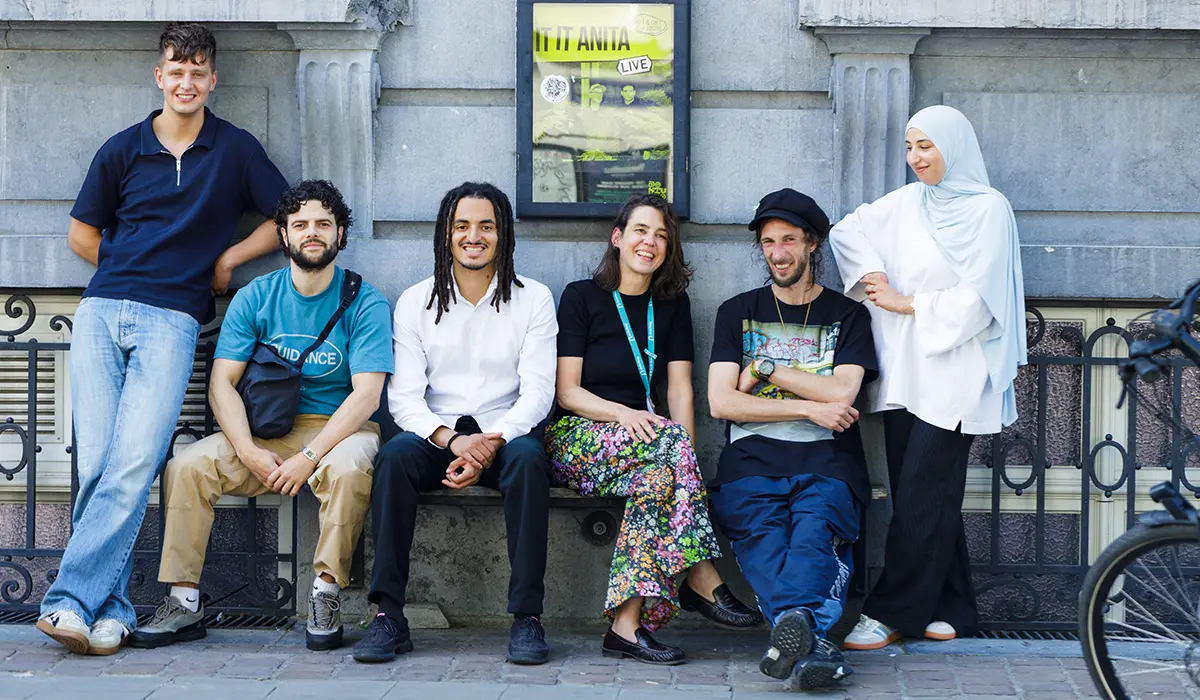
Eight local ecosystems, sixteen Work Packages, and over 400 young people and youth workers who trusted us with what keeps them up at night — here’s what the first phase of COSY has taught us.
Since the spring of 2026, Uit De Marge and the Amsterdamse Jongerenwerk Academie (AJA) have been coordinating COSY — COmmunity Safety through Youth participation at local level — a project funded by the European Union’s CERV programme (Citizens, Equality, Rights and Values). Whether you’ve been following COSY from day one or are hearing about it for the first time: this is a good moment to take stock. Phase 1 closed at the end of August 2026, and we want to share what it produced — not only the numbers, but the story behind them.
What is COSY, in a nutshell?
COSY starts from a simple but often overlooked idea: young people at risk of being excluded by society or by institutions, and the outreach youth workers who support them, are themselves the experts on what makes their neighbourhood feel safe — or unsafe. Rather than asking policy-makers or researchers to guess, COSY goes directly to young people and youth workers, in eight local “ecosystems” across Belgium and the Netherlands, and asks them to name their own “local community safety signals”: recurring patterns that affect how safe, well and included they feel.
Those eight ecosystems are: Borgerhout and Deurne, Ghent, Geraardsbergen, Dilsen-Stokkem, Lanaken, Amsterdam North and Amsterdam New-West. In every one of them, COSY worked with two groups: young people themselves, and the outreach youth workers and youth development workers who walk alongside them every day.
One shared process, eight very different neighbourhoods
To make sure signals from Antwerp and signals from Amsterdam could genuinely be compared, every single one of COSY’s 16 Work Packages followed the same underlying process: a shared working definition of what counts as a “local community safety signal”, a five-step decision tree to test whether an observation truly qualifies, a common template for capturing it, and a shared framework for eventually scoring and prioritising validated signals.
What varied, deliberately, was how that process was brought to life on the ground. Local teams used post-it exercises organised by life domain, neighbourhood mapping, “boat exercises” to chart trusted networks or who is (not yet) reached, barbecues where recurring signals were tested as statements, months of sustained street-level outreach, a “Flip-thinking” training that doubled as a professional development moment, graffiti workshops, and one-to-one conversations. The method always fit the group in front of the project worker — never the other way around.
A few ecosystems went a step further and deliberately tested signals gathered from young people with independent groups of youth workers — in Ghent and Geraardsbergen, this produced striking, near-verbatim confirmation of the same signals from different professionals, which gives everyone involved real confidence that what was captured reflects genuine, shared experience rather than one person’s story.
Who did we reach?
- 16 Work Packages completed
- 8 local ecosystems
- 400+ direct participants
- 2 target groups: young people & youth workers
Across the eight ecosystems, more than 400 people took part directly in a COSY activity — roughly 217 young people and 190 outreach youth workers and other professionals working with young people (street coaches, ambulant supervisors, youth and safety officers and individual-support workers…). In Ghent alone, four months of sustained street-based outreach brought the project worker into contact with an estimated 70 young people, well beyond the number who formally signed a participant list — a reminder that COSY’s real reach is often wider than what any single figure can capture.
And behind every one of those 400+ direct participants stands a much larger circle: families, peers, and the dozens of partner organisations — KRAS, JES, SAAMO, Stampmedia, De Wereld van Rayaan, Betonne Jeugd, VZW Jong, Jong Gent In Actie, Jeugdstraathoekwerk Gent, PerMens/VIA, the Red Cross, and municipal youth services in every ecosystem — who opened doors, made introductions, and made this outreach possible in the first place.
Progress and timing
Phase 1 ran from March to August 2026. It began with a kick-off conference and the roll-out of COSY’s shared toolkit, moved through a busy summer of activities across all eight ecosystems, and closed with the consolidation of 16 monitoring & evaluation reports. Along the way, two things stood out. First, summer holidays are a real constraint for youth work capacity and second, “done” isn’t always a straight line. We think that kind of transparency — about what worked and what didn’t, the first time around — is exactly the spirit COSY is meant to embody.
Built on cooperation, at every level
- European: COSY is funded by the EU’s CERV-2025-CITIZENS-CIV programme, designed to produce insights that are meaningful at a European level.
- Transnational: Uit De Marge (Belgium) and the Amsterdamse Jongerenwerk Academie (Netherlands) coordinate the project together, pairing Flemish and Dutch youth-work traditions.
- Regional: where local youth-worker capacity was thin, activities were deliberately opened up to a wider region.
- Local: in every ecosystem, COSY leaned on existing, trusted relationships with local youth work organisations, schools, municipal services…
What the signals are telling us
Across all 16 Work Packages, a number of themes recur again and again — named independently, in different words, by young people and youth workers who have often never met each other:
- Trust in the police is fragile, shaped above all by repeated ID checks and a sense of being profiled.
- Public space does not feel equally safe for everyone — girls and young women, in particular, describe limiting their own movement out of caution rather than responding to one specific incident.
- Housing insecurity and homelessness are a growing concern, increasingly named as the single most urgent issue by professionals working with the most vulnerable young people.
- Social media amplifies existing pressures — from harmful role models to extortion — more than it creates new ones, and is named far more often by professionals than by young people themselves.
- What consistently works is a trusted adult and a low-threshold place to be — named, independently, in almost every single ecosystem.
These signals — and the many more specific, local ones behind them — are exactly what Phase 2 will build on: a Library of intermediate stories that makes them shareable, the deliberate creation of safe spaces, and structured moments where young people’s and youth workers’ own voices reach local policy-makers and representatives of government institutions directly.
A word of thanks
None of this would exist without the young people and youth workers across eight ecosystems who were willing to speak openly — often about difficult things — because they trusted that it would be worth something. And it would not exist without the COSY project team who made that trust possible: who showed up, session after session, in youth centres, on street corners, at barbecues and around kitchen tables, to listen well and capture it faithfully.
A warm and well-deserved shout-out to the whole COSY project team: Chaymae Safir, Jonathan Eggermont, Kihndé Ait El Kadi El Morabti, Evelien Nijland, Jan Pieter Jansen and Esra Jansen — and everyone at our partner organisations across every ecosystem who made this work possible. Thank you.
Curious to follow COSY into Phase 2? There’s plenty more to come.