


Heading towards Phase 2: the Library of Intermediate Stories as a compass
How do we give young people real room to act as changemakers? COSY project coordinator Eva Van den Noortgate went looking for an answer in Amsterdam… and found a method that will help shape Phase 2 of COSY.
Phase 1 of COSY produced hundreds of safety signals, gathered directly from young people and youth workers across eight ecosystems. But collecting signals is one thing; getting them to land with policy-makers and societal institutions in a way that does justice to the young people who shared them is another challenge entirely. That is why, in Phase 2, COSY is drawing on the Library of Intermediate Stories — a method built on four years of experience in Amsterdam, and one that connects seamlessly with how COSY has approached young people as full changemakers from the very start.
What is an intermediate story?
An intermediate story is not a story about young people, but a story that emerges between people, worlds and perspectives — in the encounter itself. These are the stories young people carry about their own development and change, yet they often remain untold: because they are too complex, because the storyteller isn’t given the position to speak, or because as a society we would rather look at problems than at the dexterity that lies behind navigating between different worlds.
That is exactly where the strength lies: young people who have to move between the margin and the mainstream — between home and school, between culture and the dominant norm, between what is expected and what they themselves feel — develop a form of knowledge that is rarely recognised. The Library of Intermediate Stories makes that knowledge visible, shareable and valuable.
Room to act as a precondition: arranging agency
This approach ties in closely with ‘Arranging Agency: Room to Act for Young People as Changemakers’, the practical guide published in December 2023 by Amsterdam’s Centre of Expertise on Inequality. Its core message: young people growing up in a position of inequality are constantly adapting to existing realities — but real change doesn’t require even better-adapted young people. It requires adults and institutions who actively arrange room to act, so that young people can help shape those realities themselves.
Agency — the ability to steer your own life and environment — is therefore not a trait a young person either ‘has’ or doesn’t, but something that emerges in the space we create together. COSY recognises that exact principle in the Library of Intermediate Stories: not just listening to young people, but putting them at the wheel of what happens with their own story.
At a symposium in Amsterdam: an afternoon on the power of stories
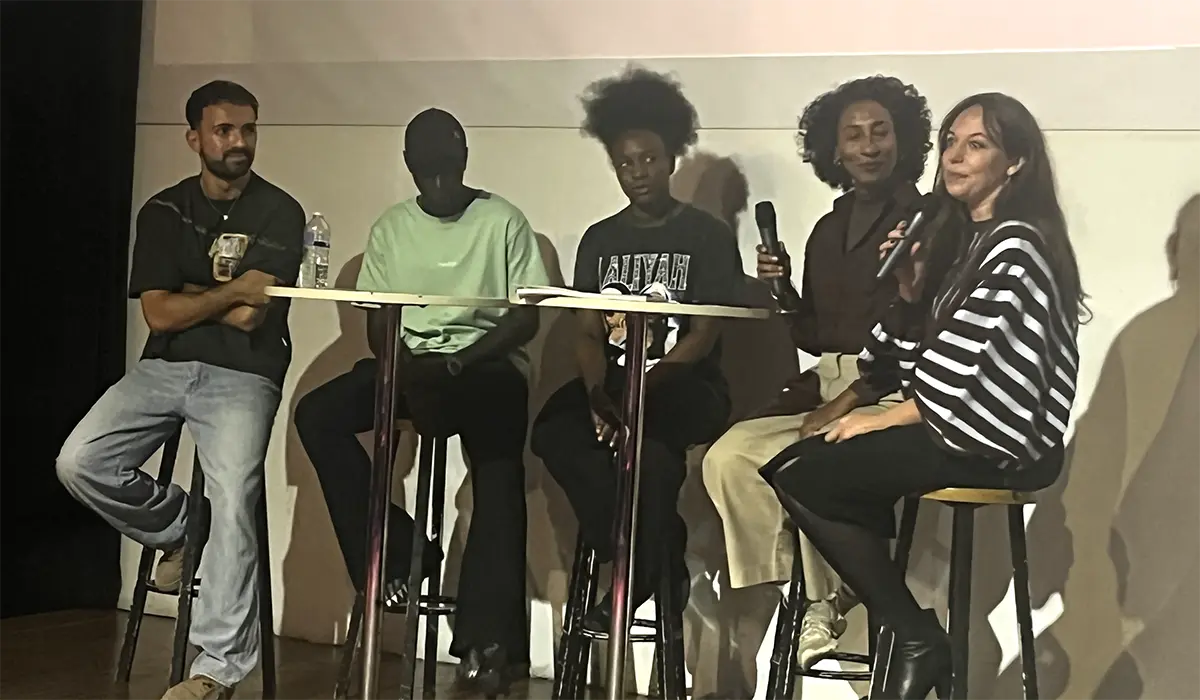
To think this room to act through further, Eva attended a symposium on 10 September 2026 at de Jungle in Amsterdam, organised around the Library of Intermediate Stories. What once began as the brainchild of Femke Kaulingfreks and Sebastian Abdallah has since grown into a movement carried by, among others, Sociaal Cement, Criminal Minded, Fonds ZOZ, Stichting Sitara, Vrije Universiteit Amsterdam, Inholland University of Applied Sciences, Universiteit voor Humanistiek, and the Amsterdam University of Applied Sciences (HvA) — and, more recently, a Masterclass Intermediate Stories in which young people themselves take on the role of teacher.
Starting from love, not from judgement
The tone was set right away by a musical introduction from Rivelino Rigters (author of Bloedband), who used his song ‘Liefde is’ (‘Love is’) to speak about his work with people in detention — from love, not from judgement. Dr Sebastian Abdallah (Universiteit voor Humanistiek), co-founder of the Library of Intermediate Stories, built on that: young people who can navigate between the margin and the mainstream are not inherently vulnerable or problematic — it is precisely that dexterous position that means they carry intermediate stories we, as adults, can learn from. In the Library, pedagogy, culture and politics come together; though going through that shared learning process, and sharing power with young people, is far from easy.
Art as a bridge
Architect, actor and theatre-maker Oudail el Omari showed how art can build that bridge. Theatre taught him the language and brought him friends; from there, he expanded into photo exhibitions, installations and collaborations with other artists in ‘in-between positions’. With the exhibition Between Land and Sky, Between Borders, We Meet, he showed how music, poetry, architecture and collective memory make the resilience of Arab communities visible — art that doesn’t just tell a story, but heals.
Three conditions for a safe space
In the panel discussion, led by Jessica Van der Luyt (Stichting Sitara) and Elena Ponzoni (Vrije Universiteit Amsterdam), experts by experience Ousmane, Shanti Monkou and Oudail el Omari shared why intermediate stories are told so rarely — and why, precisely for that reason, they can offer so much recognition, comfort and hope. The message to adults: look at the young person’s qualities and listen just as closely to what remains unsaid. Asked how an organisation can create a safe space for intermediate stories, the room answered, unanimously, with three conditions:
- Really listen, without interrupting.
- Equality and genuine curiosity, without infantilising.
- Honesty.
Performer Ousmane brought his track ‘Message’ live, with the video playing behind him: he may not be able to go everywhere he wants, but his message reaches everywhere through social media.
Experiencing it first-hand
In the workshop ‘From my story to their story’, led by Coen van Heteren (Sociaal Cement) and Sebastian Abdallah, participants experienced for themselves what stories, navigating between different worlds, and imagination can set in motion. The exercise let go of the one-sided, problem-focused way of looking at stories, making room instead for depth, and for the different layers and versions within the same story — a concrete shift from working ‘for’ young people to working ‘with’ them.
From deficit to potential
Femke Kaulingfreks, professor of Urban Youth Studies (Wibaut Chair, University of Amsterdam), closed the afternoon with her own mission: bringing about a shift in perspective, among everyone who works professionally with young people, from deficit to potential. We don’t have to reduce boys with externalising behaviour to nuisance-causing ‘problem youths’, nor automatically label girls with internalising behaviour as victims. We can just as easily choose to see their drive, their longing and their capacity for change — and support them in developing it further.
“The child that is not embraced by the village will burn it down to feel its warmth.”
That African proverb, quoted in closing, helps explain why young people can sometimes be so unruly: where there is no attention, they will claim it.
What this means for COSY Phase 2
For COSY, that afternoon confirmed a conviction that had already been growing throughout Phase 1: the hundreds of signals that young people and youth workers shared with us are themselves already intermediate stories — born in the encounter, on street corners, over barbecues, in graffiti workshops and around kitchen tables. In Phase 2, we don’t just want to bundle those stories — we want to genuinely create room to act with them:
- Our own Library of Intermediate Stories, inspired by the Amsterdam example, which turns the signals from all eight ecosystems into shareable stories — without flattening their layers or different versions.
- The deliberate creation of safe spaces, built on those same three conditions voiced in Amsterdam: really listening, equality without infantilising, and honesty.
- Structured moments in which the voice of young people and youth workers reaches local policy-makers and representatives of societal institutions directly — not as an illustration of a problem, but as a starting point rooted in potential.
In short: from collecting signals to arranging room to act. To be continued in the next chapter of this story.